EVAM PIP: a mobile, autonomous EV charger concept
A speculative concept for the future of EV charging: a charging pod that drives itself to cars in Singapore carparks and returns to its dock. I came up with the pod-and-dock idea and built the life-size working model.
- Period
- Spring 2025
- Context
- SUTD Product Design Studio · EVAM Interior Team, 5 people · Technical lead
- Stack
- C++ · ESP32 · Motors · Actuators · 3D printing · Blender
- Result
- Life-size working model
- Links
- Team report (PDF) →Poster (PDF) →
The problem
EV charging is held back by land and cost: fixed chargers take up space and are expensive to install. Singapore's carparks make that worse, with tight layouts and strict size limits that conventional chargers aren't designed around. The result is downtime between cars and less coverage from each charger.
The concept
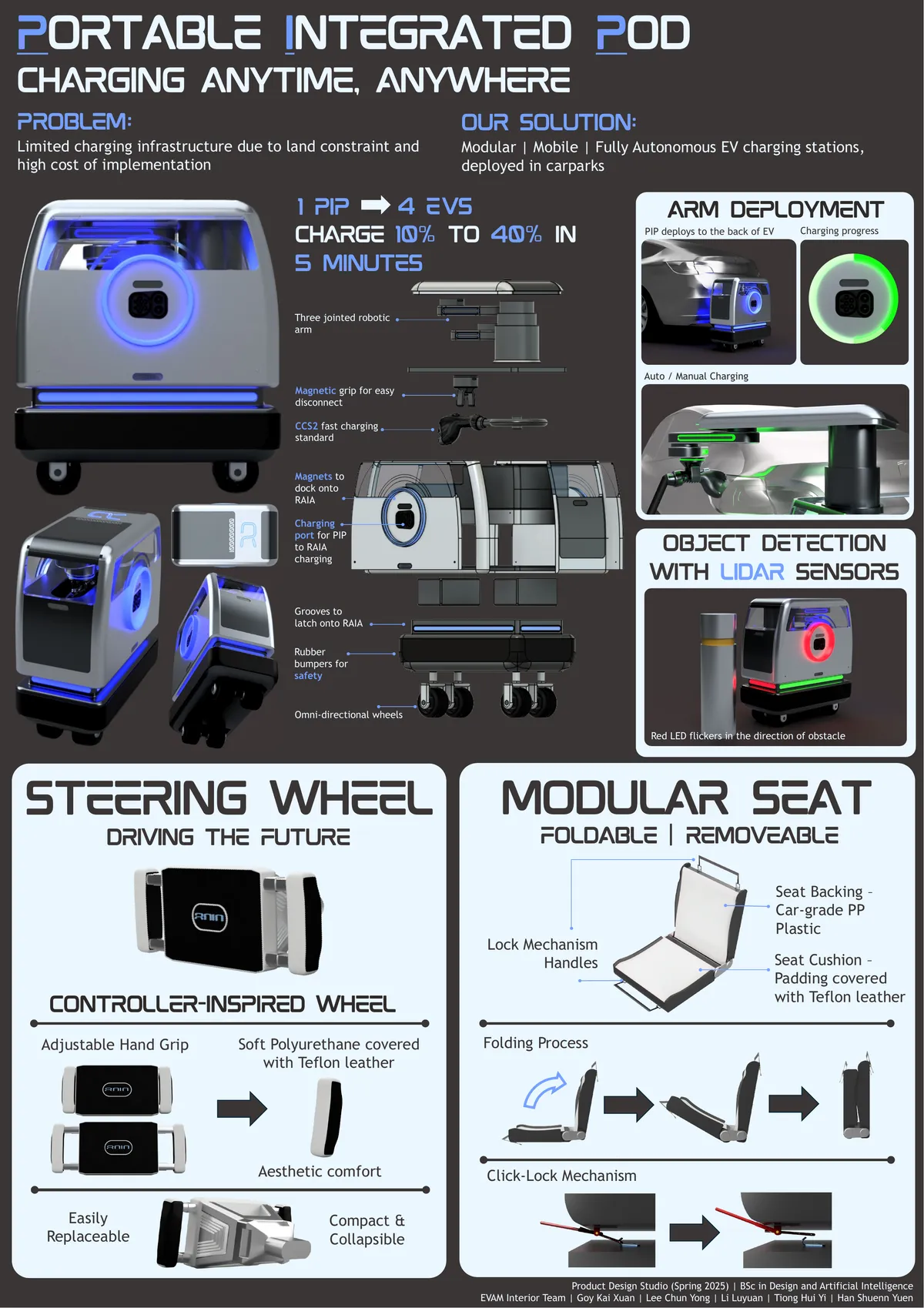
EVAM is a speculative concept for the future of EV charging. Our team designed the interior of the EVAM vehicle and the Portable Integrated Pod (PIP): a modular, mobile and fully autonomous charger that drives to a parked car, plugs itself in, and returns to RAIA, a dock where it recharges.
The idea of pairing a mobile charger (PIP) with a dock it returns to (RAIA) was mine.
On paper, one PIP serves four cars, taking each from 10% to 40% in about five minutes. Those figures are concept targets, extrapolated from where battery and fast-charging technology was heading at the time. They were not measured.
How PIP works, as designed
- A three-jointed robotic arm deploys to the back of the car and connects, automatically or manually.
- CCS2 fast-charging connector, held by a magnetic grip so it disconnects easily.
- LiDAR object detection, with a red LED that flickers in the direction of an obstacle.
- Omni-directional wheels and rubber bumpers for moving safely around a carpark.
- Magnets and grooves to latch onto RAIA, and a charging port to recharge from it.
My role
- Came up with the PIP and RAIA pairing at the heart of the concept.
- Technical lead for the team of five.
- Built the life-size working model of PIP, including the robotic arm, from an ESP32, motors, actuators and 3D-printed parts.
Also designed by the team
- A controller-inspired steering wheel with adjustable, replaceable grips that collapses for storage.
- A foldable, removable modular seat with a click-lock mechanism.
Outcome
- A working life-size model of PIP with a functioning robotic arm.
- A Blender product film and an A1 project poster (below).
- The result went beyond what the team and our professors had expected.